
Prof. Dr. Peter Westhoff bids farewell
© C. Wagner

© S. Köhler

© C. Wagner

© S. Köhler

© S. Köhler

© C. Wagner
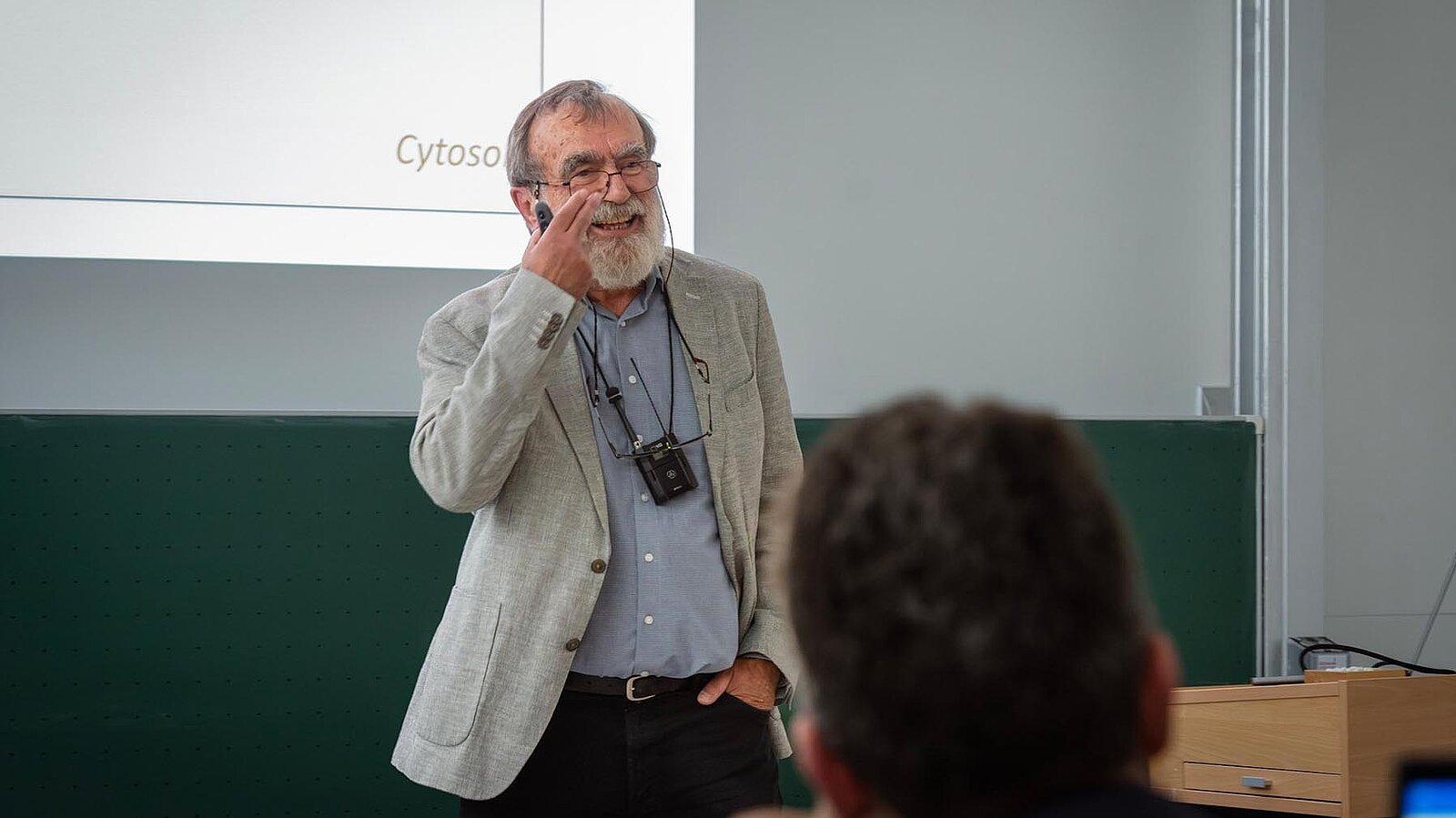
On Friday 3 July 2026, Prof. Dr Peter Westhoff delivered his farewell lecture at Heinrich Heine University Düsseldorf (HHU) on the topic ‘From single-celled green algae to maize as a crop – a research journey through photosynthesis’. This was followed by an informal gathering in the Botanical Garden, which Westhoff had headed as director since 2010. The event marked the culmination of an outstanding academic career that has had a lasting impact on HHU, plant research and German science policy over the decades.
Peter Westhoff was born in Warburg-Welda in 1951. His educational journey is typical of a generation for whom an academic career was by no means a given, but rather depended on personal initiative, a willingness to work hard and the educational opportunities that were available at the time. He studied biology, chemistry and educational psychology at Justus Liebig University in Giessen. After passing his state teaching qualification in 1977, he obtained his doctorate there in 1980, before completing his habilitation in botany at Heinrich Heine University Düsseldorf in 1985. Following a two-year stint at the University of Munich, he accepted a chair in Plant Developmental and Molecular Biology at HHU in 1988.
Over many decades, Peter Westhoff has shaped the university in the very best sense of the word and served it in a wide variety of roles. He was Executive Director of the Biology Research Unit, Vice-Dean of the Faculty of Mathematics and Natural Sciences, and its Dean from 2004 to 2007. From 2010 onwards, he headed the HHU Botanical Garden, before helping to shape the university’s strategic development as Vice-Chancellor for Research and Transfer from 2014 to 2020. Looking back, it is clear just how formative these years were for the university’s research development. Peter Westhoff did not view the role as an administrative task, but as a scientific responsibility to shape the future. Taking on responsibility came naturally to him. In doing so, he always acted in the best interests of the team – for the sake of the university and the common cause, never with the aim of putting himself in the spotlight.
His scientific interest centred primarily on photosynthesis – in particular, the question of how the highly efficient C4 photosynthesis, found in maize for example, has developed independently on several occasions over the course of evolution, and how this knowledge can be applied to other crops. To answer these questions, Peter Westhoff was among the first scientists to recognise the potential of the plant genus Flaveria and to use it as a model system to systematically investigate the evolution of highly efficient C4 photosynthesis and the C3-C4 transitional forms. Through his research, he was involved in numerous national and international projects. From 2007 to 2012, he was spokesperson for the Collaborative Research Centre (SFB) 590 and, in 2012, was one of the initiators of the CEPLAS Cluster of Excellence, which was jointly established by the Universities of Düsseldorf and Cologne.
Peter Westhoff has left a lasting mark on CEPLAS. For many years, he coordinated the Photosynthesis research division and was far more than just its scientific director. Generations of early-career researchers have benefited from his experience, his openness and his willingness to take the time to answer their questions. Even after stepping down from his active role, he remained closely connected to CEPLAS as a mentor, offering the cluster advice, practical assistance and a great deal of personal support.
His wealth of experience within the academic system, his keen sense of academic rigour and his strategic vision made him a highly valued adviser far beyond the confines of the university. Whether as Vice-Chancellor, in inter-university initiatives or in the development of new research projects – Peter Westhoff never shied away from playing the role of devil’s advocate. With his critical and sometimes uncomfortable questions, he helped to refine ideas, clarify arguments and further develop projects. Countless colleagues and early-career researchers benefited from this ability.
His many years of service as an expert reviewer for organisations such as the German Research Foundation (DFG), the Federal Ministry of Education and Research and the French Agence Nationale de la Recherche, as well as his membership of the DFG Senate from 2006 to 2012, reflect the high level of trust placed in him by the scientific community.
In 2013, Peter Westhoff was elected to the German National Academy of Sciences Leopoldina. This honour recognises not only his research achievements but also his commitment to science and science policy.
However, those who worked with Peter Westhoff will remember more than just his academic achievements. He was always known at the university for his pragmatic and down-to-earth manner. He also always approached new ideas with openness and curiosity rather than with reservations. Long before ‘science communication’ became an established term, he championed, with great conviction, the cause of communicating research in an accessible way and highlighting its significance for society. His approach was always characterised by a high degree of diligence and professionalism, as well as a clear focus on results, which made him a reliable and valued partner in research, teaching and higher education policy.
Above all, however, Peter Westhoff is, for many of us, an open-minded person to talk to. His door is always open – not only for academic questions, but also for discussions about everything that makes up life at a university and beyond. With great personal interest, a subtle sense of humour and intellectual curiosity, he is able to listen, engage in passionate discussions and provide food for thought. Many encounters with him are therefore far more than just academic exchanges.
We would like to thank Peter Westhoff warmly for everything he has done for the university, for CEPLAS and for the many people whose journeys he has accompanied. We look forward to him remaining connected to us – hopefully for a long time to come – as a valued mentor, adviser, source of ideas and, not least, an inspiring conversation partner.