
Advancing Genome Editing in Rice together
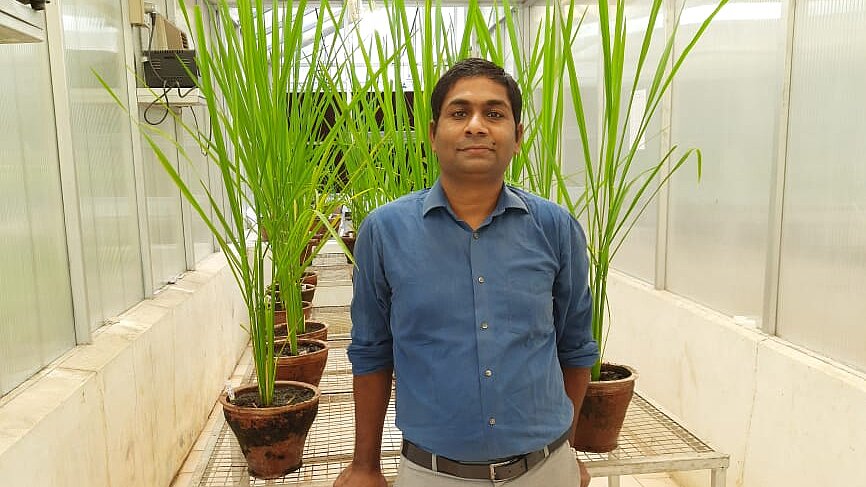
Dr. Satendra Mangrauthia has returned to the Institute of Molecular Physiology at Heinrich Heine University Düsseldorf as a visiting scientist, continuing a long-standing and highly productive collaboration in the field of plant genome editing. His renewed stay marks the next phase of joint efforts to further improve elite rice varieties through precise genetic modifications.
One of the most prominent outcomes of this collaboration is the genome-edited rice variety Kamala, which was developed by fine-tuning the activity of a cytokinin oxidase gene. Results from nationwide field trials conducted within the All India Coordinated Research Project on Rice (AICRIP) demonstrate that Kamala achieves an average yield increase of 19 percent compared to established reference varieties.
These findings highlight the potential of genome editing as a precise and efficient tool to enhance crop productivity under real-world agricultural conditions. The underlying scientific results have been made publicly available as a preprint on bioRxiv (https://doi.org/10.64898/2026.01.23.701329).
The development of Kamala was carried out in close collaboration between Indian research institutions and partners at Heinrich Heine University Düsseldorf. The university is recognized as a co-inventor in the associated patent, with CEPLAS member Prof. Wolf B. Frommer contributing both as an inventor and as a co-author of the scientific publication.
The variety has now been officially registered in India and may be approved for cultivation under current national regulations, as it does not contain transgenic sequences. Nonetheless, its registration has sparked public debate. The Coalition for a GM-Free India has voiced criticism, prompting the Indian Council of Agricultural Research to issue an official statement clarifying the scientific and regulatory classification of genome-edited crops such as Kamala.
During his current stay in Düsseldorf, Dr. Mangrauthia is working on extending genome editing approaches to additional rice varieties, aiming to further enhance yield stability and stress resilience. His work exemplifies the importance of international collaboration in translating fundamental research into tangible agricultural innovations.