
Prof. Dr. Khaled Selim
Research focus
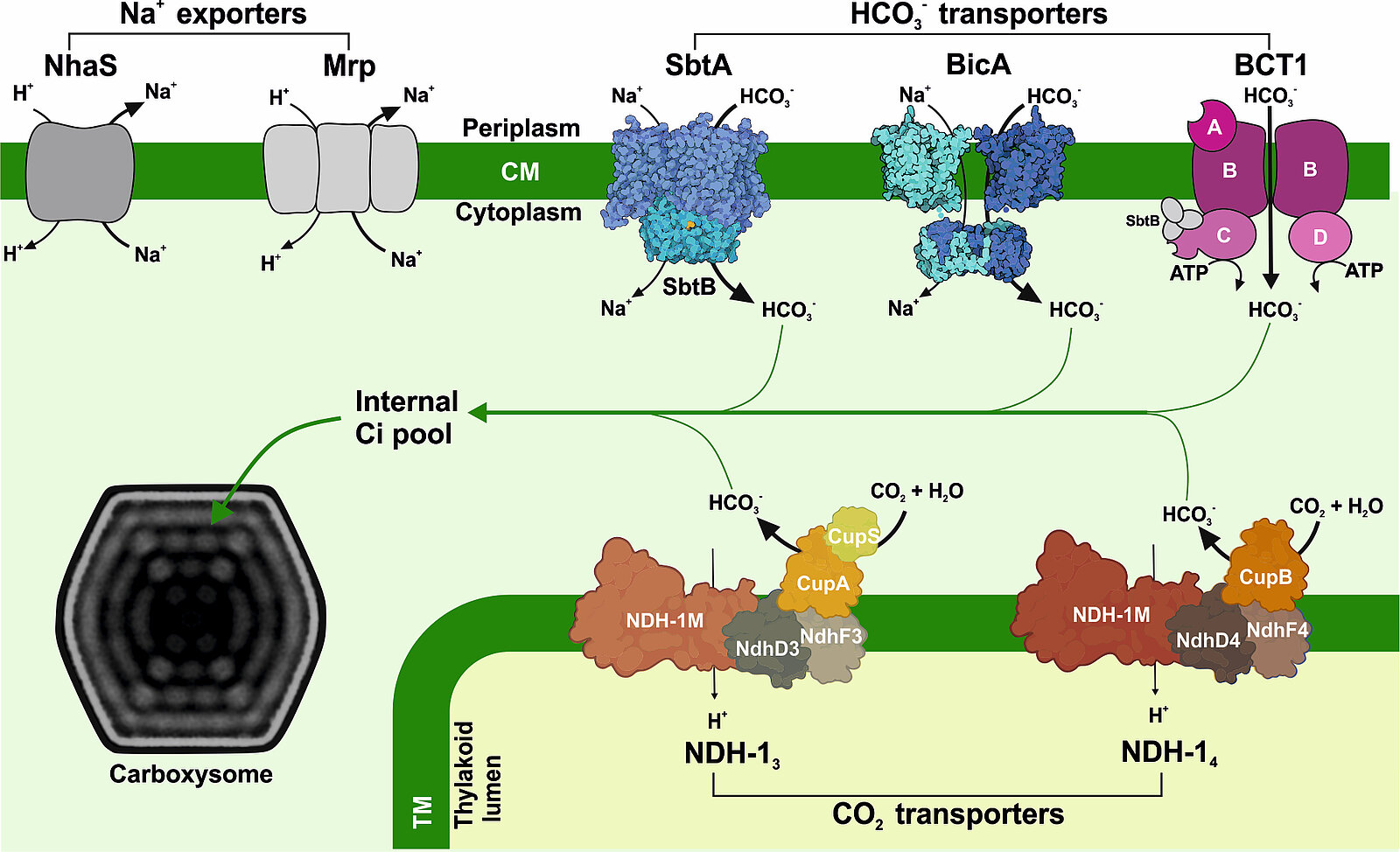
To ensure efficient CO2 fixation, cyanobacteria evolved a carbon concentrating mechanisms (CCM) to elevate CO2 concentrations around CO2 fixing enzymes (RubisCO and phosphoenolpyruvate carboxylase [PEPC]) via several uptake systems for active transport of HCO3- (SbtA, BicA and CmpABCD) and CO2 (NDH-I3 and NDH-I4 complexes).
Our research aims to understanding the molecular and structural mechanisms of HCO3- transporters, their functional link to CO2 fixation by (PEPC and RubisCO), and their regulation by PII signaling proteins. This work will greatly improve our understanding of cyanobacterial CCM and provide a rational basis for designing synthetic strategies to correctly install these enzymes/transporters into other microbes or chloroplast to enhance carbon assimilation pathways.
Most important publications
- Zimmer E, Poppitz C, Klahn S, Selim KA (2026) Functional and structural insights into cyanobacterial CO(2) concentrating mechanisms: from compartmentalization to regulation. Plant J 126(5):e70974. doi: 10.1111/tpj.70974.
- Haffner M, Enkerlin AM, Mantovani O, Spat P, Macek B, Hagemann M, Forchhammer K, Selim KA (2025) Diurnal rhythm causes metabolic crises in the cyanobacterial mutants of c-di-AMP signaling cascade. iScience 28(9):113261. doi: 10.1016/j.isci.2025.113261.
- Selim KA, Haffner M, Mantovani O, Albrecht R, Zhu H, Hagemann M, Forchhammer K, Hartmann MD (2023) Carbon signaling protein SbtB possesses atypical redox-regulated apyrase activity to facilitate regulation of bicarbonate transporter SbtA. Proc Natl Acad Sci U S A 120(8):e2205882120. doi: 10.1073/pnas.2205882120.
- Selim KA, Haffner M, Burkhardt M, Mantovani O, Neumann N, Albrecht R, Seifert R, Kruger L, Stulke J, Hartmann MD, Hagemann M, Forchhammer K (2021) Diurnal metabolic control in cyanobacteria requires perception of second messenger signaling molecule c-di-AMP by the carbon control protein SbtB. Sci Adv 7(50):eabk0568. doi: 10.1126/sciadv.abk0568.
- Selim KA, Haase F, Hartmann MD, Hagemann M, Forchhammer K (2018) P(II)-like signaling protein SbtB links cAMP sensing with cyanobacterial inorganic carbon response. Proc Natl Acad Sci U S A 115(21):E4861-E4869. doi: 10.1073/pnas.1803790115.
Prof. Dr. Khaled Selim

Telephone+49 2118111529
Institute of Phototrophic Microbiology
Heinrich Heine University Düsseldorf
ORCID: 0000-0003-2597-7697