
Soapbox Science Rheinland Returns for Its Seventh Edition
© CEPLAS

© CEPLAS
© CEPLAS
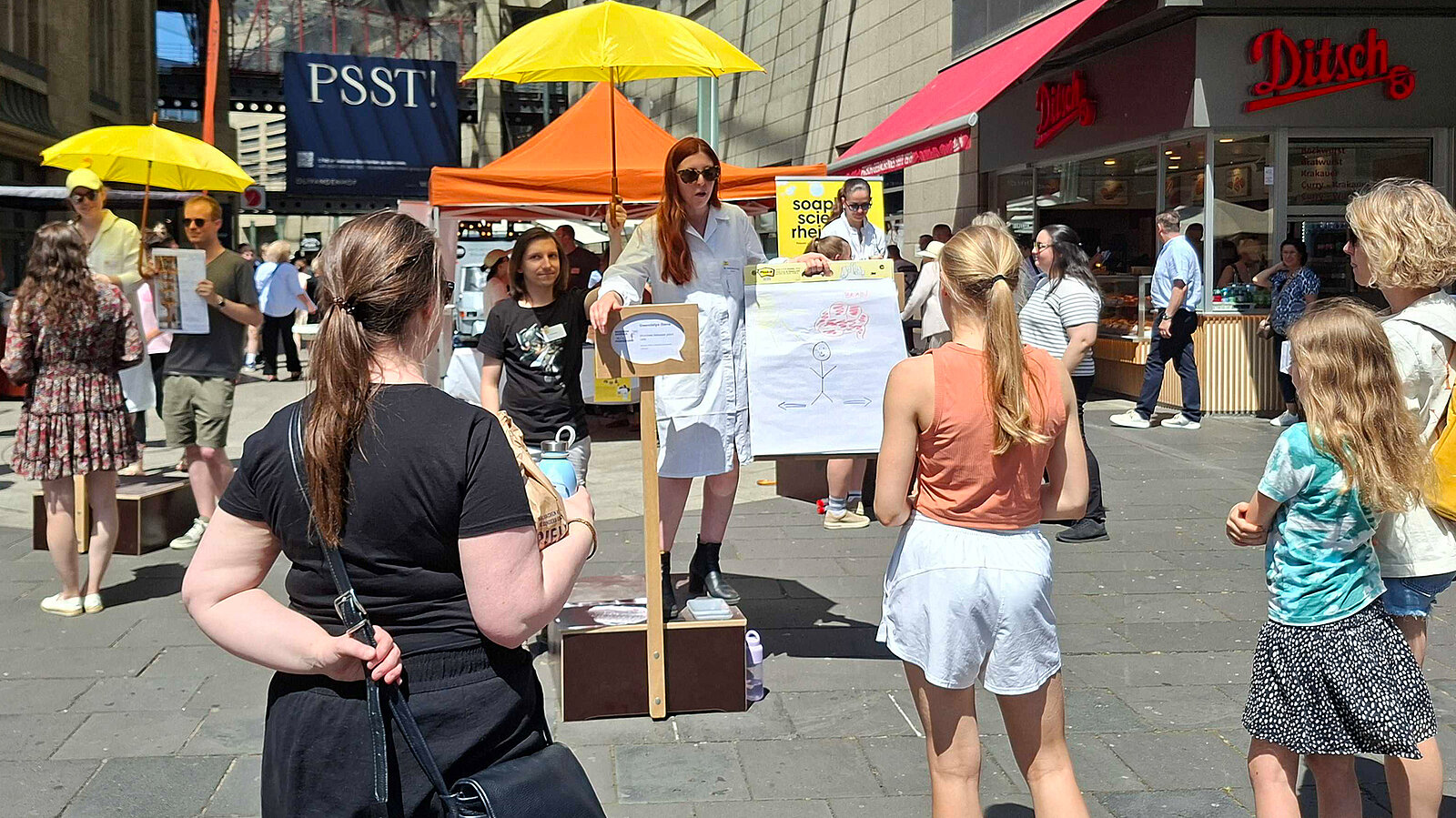
On Saturday, July 4, 2026, Cologne's city center turned into an open-air stage for science. For the seventh time overall, CEPLAS co-organised the event Soapbox Science Rheinland, bringing research directly to the public.
From 1 to 4 p.m., nine women scientists from a range of STEM disciplines, fields where women remain significantly underrepresented, presented their research in short, engaging talks, outdoors, without PowerPoint or podiums, but with eye-catching props, passion, and direct interaction with the audience. The topics ranged from quantum physics and aging research to mental health & speech, and engineering.
That's exactly why events like this matter. Putting women scientists on a soapbox and giving them the entire floor lets people see, up close, just how much great research women are doing across STEM.
Plant Science in the Spotlight: Two CEPLAS Researchers on the Soapbox
CEPLAS was represented by two researchers from the plant sciences:
- Dr. Gwendolyn Davis, Postdoctoral Researcher at Heinrich Heine University Düsseldorf, took the audience on a journey through "Windows between plant cells." Her talk explored how plant cells communicate and coordinate through nanoscopic passages between root cells, and how researchers are now mapping these hidden channels. With engaging drawings and microscope images, she explained her research in a way that was both accessible and captivating.
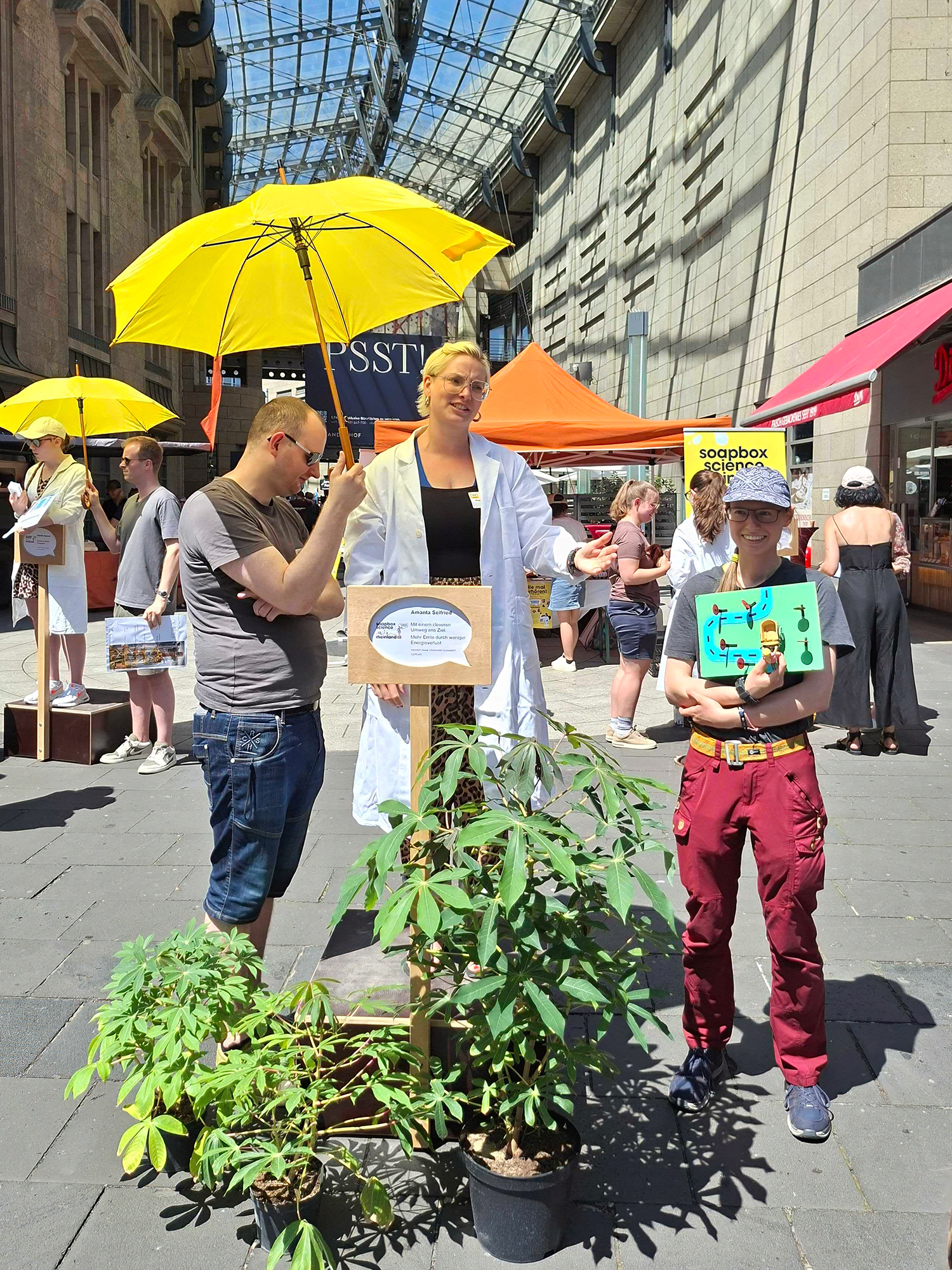
- Amanta Seifried, PhD student at Heinrich Heine University Düsseldorf, presented "A Clever Detour to the Goal: More Harvest Through Less Energy Loss" ("Mit einem cleveren Umweg ans Ziel: Mehr Ernte durch weniger Energieverlust"). Photosynthesis sounds perfect, but it isn't: plants waste a lot of energy in the process. To illustrate her point, Amanta brought a cassava plant to her soapbox. The hands-on prop was a hit with the audience, sparking excitement and lively questions about how a clever biochemical detour could help plants waste less energy and boost crop yields.
Soapbox-Science Rheinland: making Science Visible, Accessible, and Engaging
The event was co-organised by the Excellence Clusters CEPLAS, ML4Q, and CECAD. It reflects the ongoing collaboration between the Universities of Düsseldorf and Cologne in science communication, with the aim of making current research visible and accessible - right in the heart of public life- while promoting a more inclusive and open scientific culture.
Soapbox Science is an international outreach format founded in 2011 in London by two researchers, inspired by the famous Speaker’s Corner in Hyde Park. Soapbox Science Rheinland was launched in 2020 and now rotates annually between Düsseldorf, Cologne, and Bonn.
The initiative aims to make science accessible to everyone, challenge stereotypes in academia, and highlight the work of women and non-binary scientists in public spaces.