
Ancient genome function persists despite frequent mutations
© MPIPZ / CEPLAS / Xiao Dong
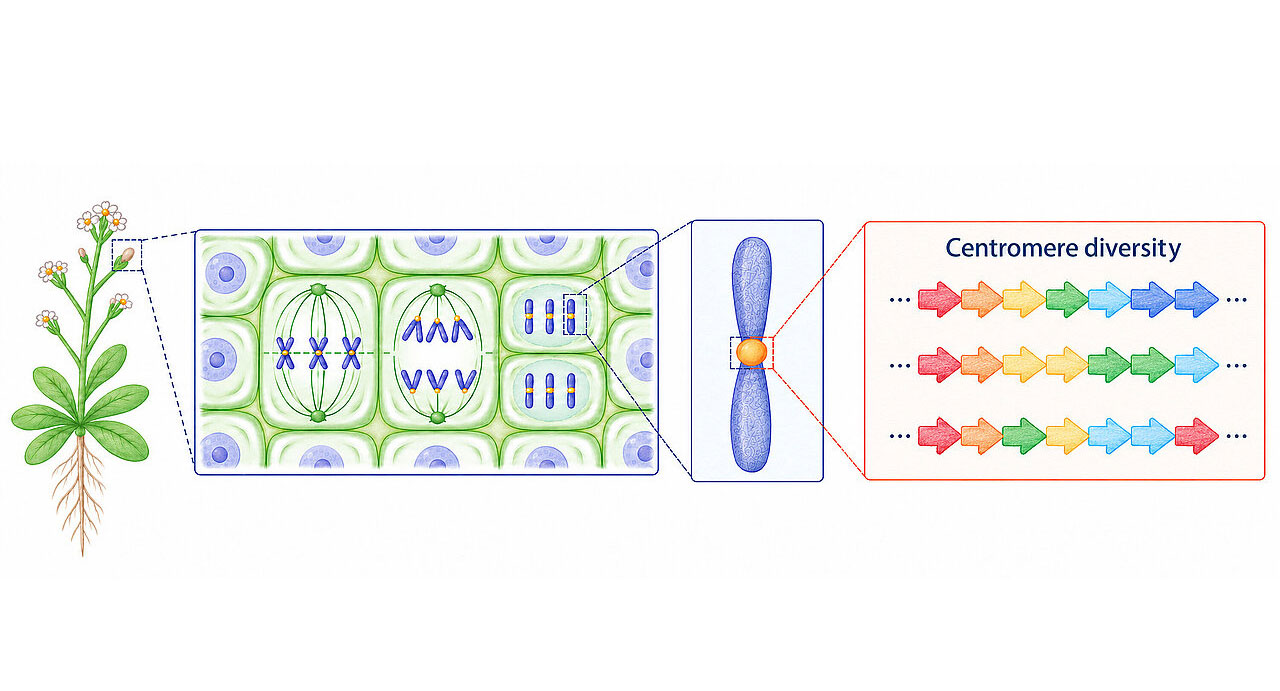
Centromeres are specialised chromosome regions that ensure chromosomes are correctly distributed when a cell divides. Thus they perform an essential function in cell division that emerged very early in eukaryotic evolution. Remarkably, although this function has been retained over almost two billion years of evolution, the DNA sequences underlying centromeres have evolved at an extraordinarily rapid rate. An international team led by CEPLAS member Korbinian Schneeberger, has now discovered how relatively small mutations can give rise to the enormous differences between centromeres.
“Centromeres are far more dynamic than one might expect for a region of the genome with such an essential function,” says Xiao Dong, CEPLAS researcher and first author of the study. “At the same time, the mutations are remarkably structured: they alter the centromere while preserving its basic repetitive organisation.”
Computer simulations demonstrated that, over thousands of generations, mutations affecting only a few thousand DNA letters can gradually produce highly similar blocks containing hundreds of thousands or even millions of letters. The findings therefore connect small, generation-to-generation mutations with the large differences observed between centromeres across individuals and species, helping explain how these essential chromosome regions can remain functionally stable while their underlying DNA evolves so rapidly.
Press release from Heinrich Heine University Düsseldorf
Original publication:
Xiao Dong, Wen-Biao Jiao, Lara Goldkuhle, Fernando Rabanal, Samija Amar, Matthew T. Parker, José A Campoy, Yueqi Tao, Bruno Huettel, Jurriaan Ton, Lisa M. Smith, Holger Puchta, Detlef Weigel, and Korbinian Schneeberger. „The mutational dynamics of the Arabidopsis centromeres“, Nature (2026) https://doi.org/10.1038/s41586-026-11046-w