
7th TRANSPLANT Day: From research to societal impact
© CEPLAS
© CEPLAS
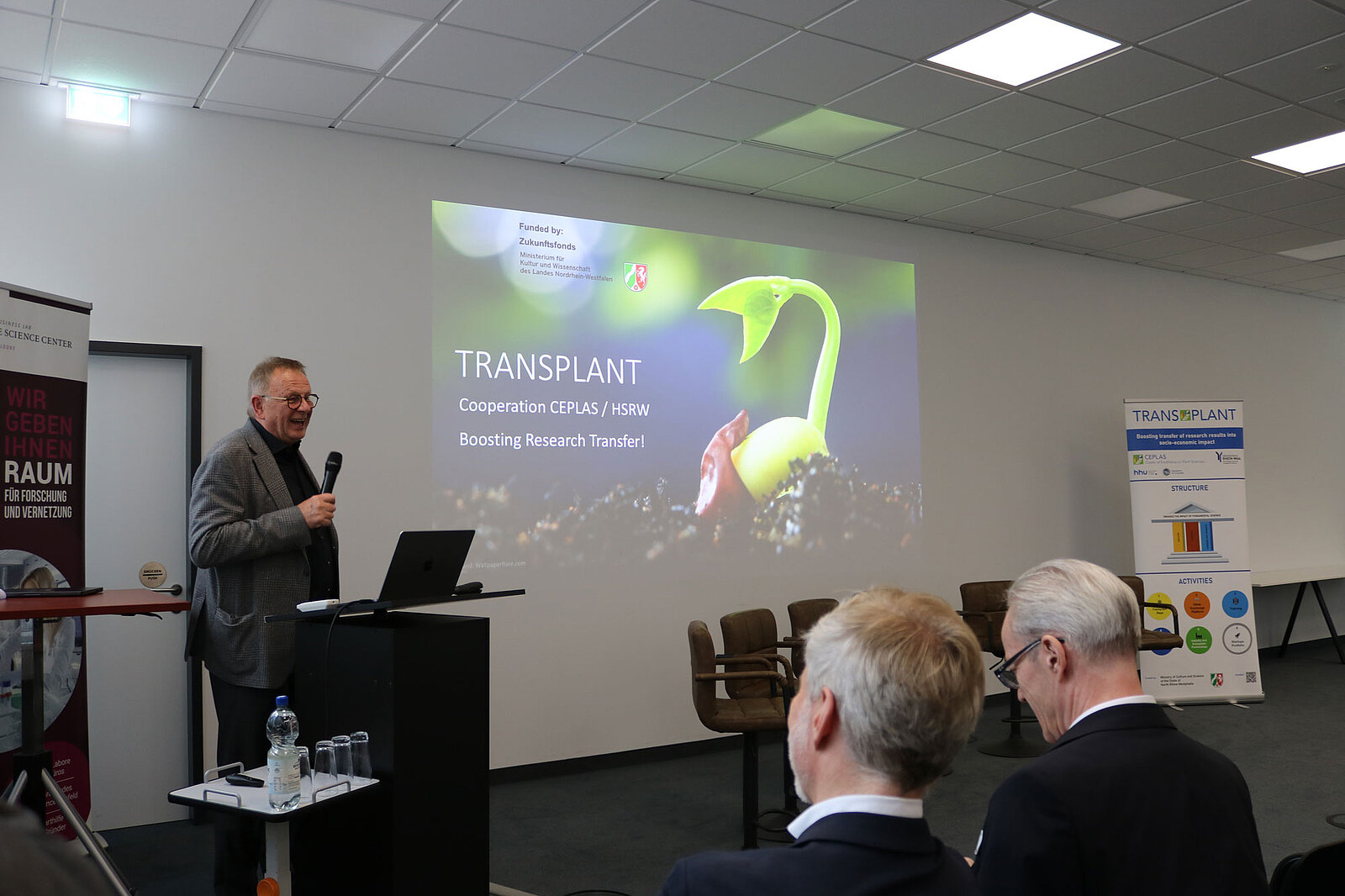
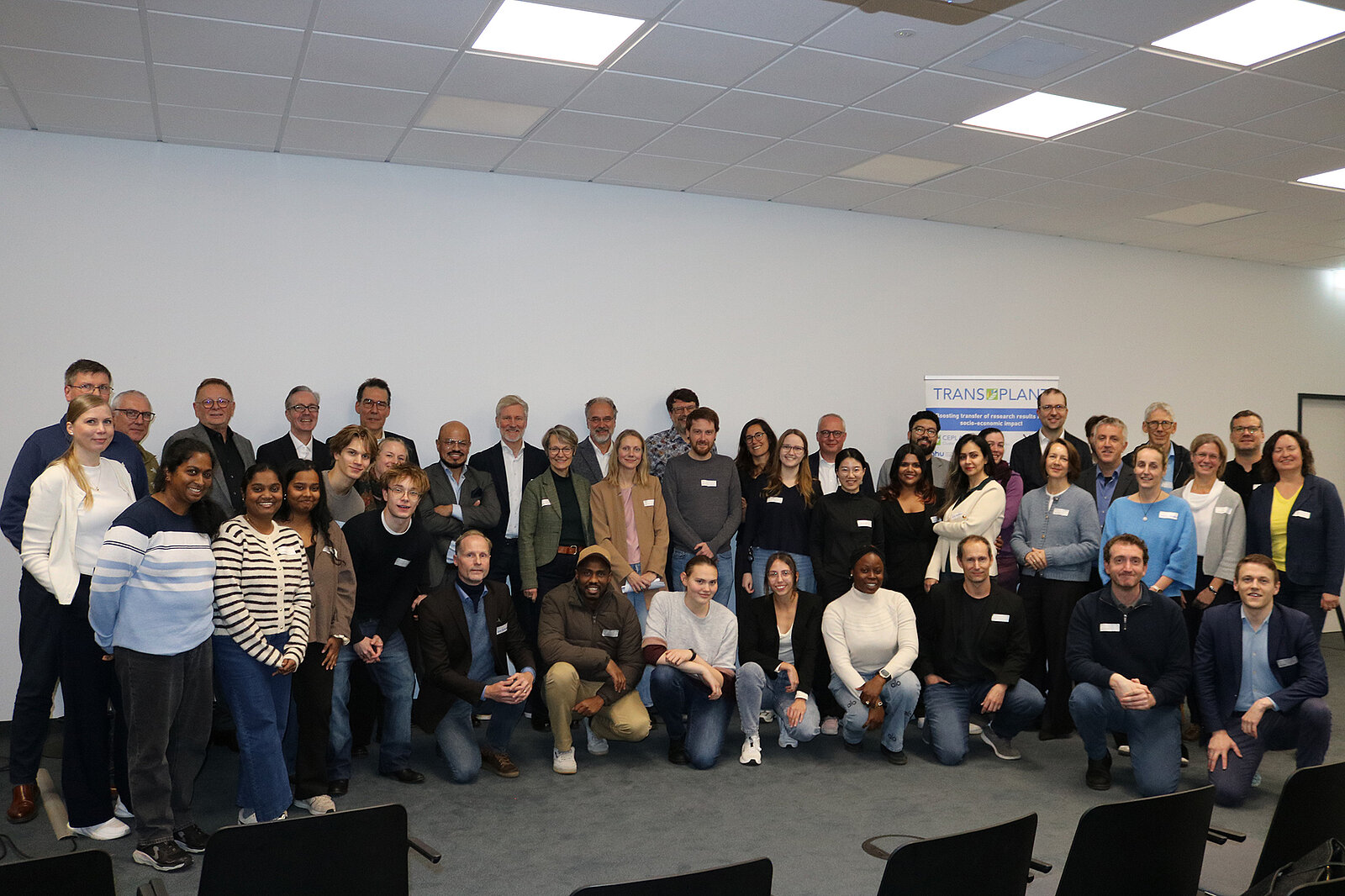
The 7th TRANSPLANT Day took place on 2 November 2026 at the Düsseldorf Life Science Center under the title “The Journey from Plant Science Research to Societal Impact”. The event brought together representatives from universities, research institutions, government and investment organizations to examine how fundamental plant-science discoveries may contribute to societal and economic impact. It also addressed how research can respond to challenges identified by society and reflected in regional policy priorities, from sustainable agriculture and climate adaptation to regional value creation. For scientists, this means opportunities to extend the reach of their work beyond academic impact, through new research questions, collaborations and, where appropriate, practical applications.
The journey: from scientific excellence to cooperation and innovation
Prof. Dr. Stanislav Kopriva presented the CEPLAS research and teaching programme, including “SMART Plants in Dynamic Environments”. The research aims to understand how plants develop and respond to changing environmental conditions, creating knowledge that may later inform plant breeding, resource efficiency and climate adaptation. Dr. Günter Strittmatter then described the role of CEPLAS technology transfer and cooperation management in identifying opportunities, handling intellectual property and connecting researchers with companies. He reported 13 ongoing transfer-oriented projects, more than ten patent applications under examination and more than 40 research-cooperation projects with over 20 private-sector partners over his twelve years tenure at CEPLAS. Dr. Thomas Welfers, Managing Director of the Düsseldorf Innovation and Technology Center (DITEC), and Irina Kordon, from the Office of Economic Development of the City of Düsseldorf, welcomed participants and introduced the Düsseldorf Life Science Center as a location supporting research-based innovation and entrepreneurship. They also guided participants through the facilities, highlighting the infrastructure and opportunities available to startups and innovative companies in Düsseldorf.
Prof. Dr. Guido Grossmann showed how TRANSPLANT builds on CEPLAS research and technology transfer through a community of researchers, entrepreneurs and external partners, combined with sustained support for individual projects. Since 2024, TRANSPLANT has not only organized TRANSPLANT Days, but also specialist training, exchanges between partner universities and participation in innovation events. His overview included startup projects at different stages of development, illustrating the importance of long term hands-on assistance with funding applications, pitch development, intellectual property and licensing, advisory networks and investment preparation. Such tailored support can help researchers choose among different transfer routes, including cooperation, licensing and startup development, which enhance the likelihood of success in achieving social and economic impact, while extending translational capabilities beyond. Grossmann emphasized the need for more publicly funded programs offering practical support to early-stage university startups, helping them bridge the “valley of death” between academic research and commercial viability and become investment-ready.
From practical needs to regional implementation
Prof. Dr. Natalie Laibach introduced BRIDGEs as a proposed continuation of TRANSPLANT's work. Drawing on the complementary strengths of CEPLAS, Rhine-Waal University of Applied Sciences (HSRW) and their partners, the concept aims to turn initial connections into concrete research collaborations, practical testing and potential innovations. It would bring scientists into earlier dialogue with farmers, small and medium enterprises (SMEs), startups, industry and applied research facilities, so that scientific opportunities and practical problems can be developed together.
In her video address, Dr. Patricia Peill, MdL, placed the journey within North Rhine-Westphalia's bioeconomy priorities. She referred to the NRW Bioeconomy Council established in 2023, the state's 2026 Bioeconomy Strategy and its ambition to become one of the world's leading regions for a sustainable bioeconomy by 2045. She stressed that fundamental research has value in its own right and that not every discovery must become a commercial product. Where applications are possible, technology transfer, pilot projects, investment and cooperation can help them progress. Prof. Dr. Ulrich Schurr followed with BioökonomieREVIER examples showing that implementation depends on more than a promising invention: trials, processing, infrastructure and partners across the value chain must fit together; researchers, innovators, industry and farmers must engage in an “innovation dialogue”, Schurr emphasized. Successful innovation ecosystems also require predictable, science-based regulation, sustained investment, public-private partnerships, and policies that accelerate the commercialization of innovation.
Skills, investment and institutional cooperation
Dr. Bernadett Simon presented the 'innovation ready' scientist, arguing that research-transfer skills should be introduced earlier and developed throughout scientific education. These include recognizing practical problems, understanding intellectual property and know-how, defining a value proposition, communicating with different audiences and negotiating with partners. She linked these skills to university transfer offices, scouting and training formats, emphasizing that they are useful for research cooperation and non-academic careers, not only for founding companies. Dr. Aurelie Nowack of the Flemish investment company PMV explained the long-term financing needs of research-intensive agricultural innovation. Her presentation connected technical and field validation, clear milestones, regulatory requirements and patient capital with the ability to attract investment and reach users. She also stressed the value of cooperation between regions: no single region offers every facility, specialist partner, investor and market required along the development path. Connections between NRW, Flanders and other European regions can provide complementary testing capacity, expertise and routes to market, linking investment readiness with regional economic opportunities.
A panel discussion, moderated by Heinz Möllenkamp, brought university leadership on stage, represented by HHU Chancellor Dr. Martin Goch and Prof. Dr.-Ing. Peter Kisters (Vice-President, HSRW), to exchange with the previous speakers on perspectives of transfer, applied research and investment and how to assess societal benefit beyond publications and patents. The panel explored key challenges in translating academic inventions into market-ready innovations, including lack of long-term proof-of-concept funding, often challenging intellectual property regulations, as well as regulatory and taxation hurdles that hamper collaboration and innovation. The panelists agreed that inter-university collaboration offers significant untapped potential to strengthen research transfer through shared researcher training, infrastructure, and joint engagement with farmers, industry, and investors.
Conclusion and outlook
The 7th TRANSPLANT Day showed how CEPLAS fundamental research, university technology transfer and TRANSPLANT's community and project support can connect with practical needs, education, finance and regional policy. The next step is to build on established cooperation, support selected projects through suitable validation and partnerships, and make their results visible to both researchers and society. As Dr. Peill's address underlined, the value of fundamental research need not be measured by commercialization alone; where relevant opportunities emerge, stronger connections across science, agriculture and industry can also contribute to NRW's sustainable bioeconomy and regional value creation.
Dr. Ricardo Godinez, Prof. Dr. Guido Grossmann
TRANSPLANT and the TRANSPLANT Days
Hosted within the Cluster of Excellence on Plant Sciences (CEPLAS), TRANSPLANT is a science community project that promotes research transfer between academia and industry to increase the impact of fundamental plant sciences. Supported by the Ministry of Culture and Science of North Rhine-Westphalia (NRW), it is a collaboration between Heinrich Heine University Düsseldorf (HHU), the University of Cologne and Rhine-Waal University of Applied Sciences (HSRW). It fosters public-private research cooperation and an entrepreneurial mindset through transfer training, intellectual property support, project scouting, business-case development and assistance with startup projects.
Seven TRANSPLANT Days have been held over the past two years. The series has addressed industry cooperation, scientific entrepreneurship, agriculture, funding and education, reaching researchers and partners across the NRW innovation ecosystem. Alongside workshops, excursions and external innovation events, the series has helped scientists explore opportunities for their work beyond academia and establish contacts with potential collaborators.