
Weitere Informationen finden Sie auf der englischen Seite.
This structure aims at providing our graduate students the theoretical knowledge as well as practical skills that are necessary to successfully conduct a research project.
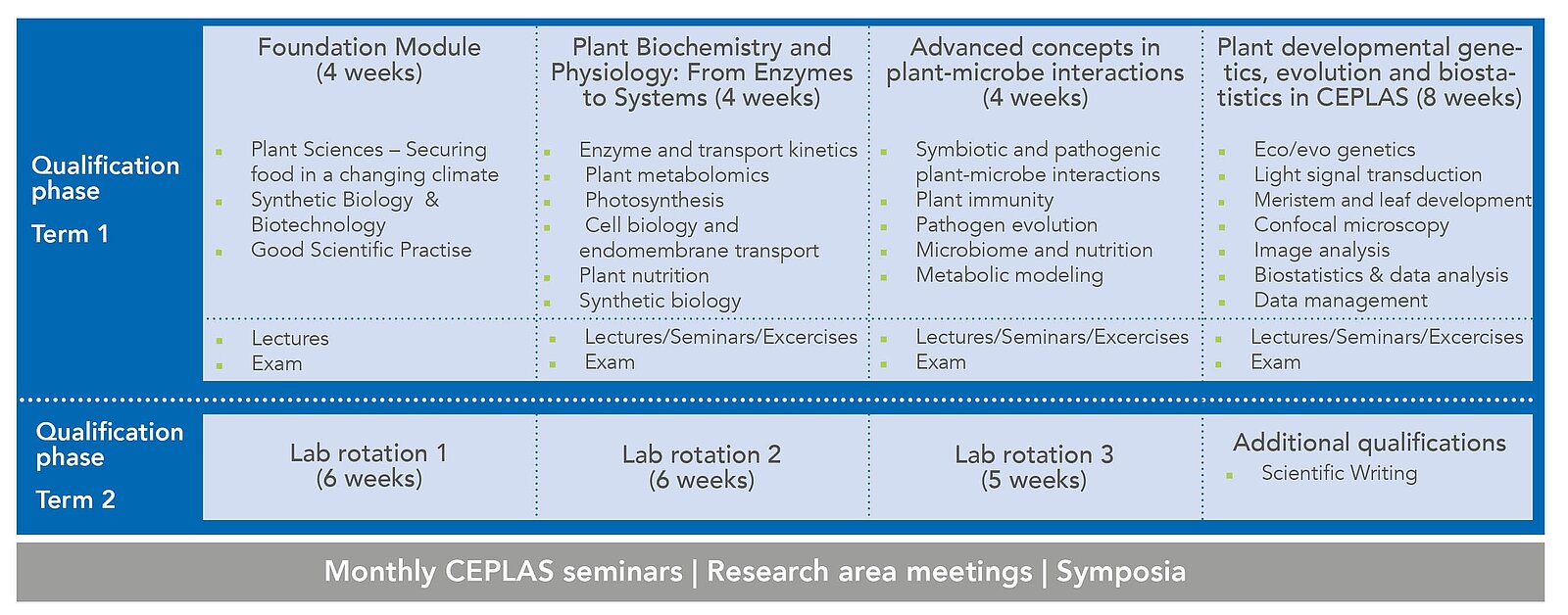
The Qualification Phase
The Qualification Phase combines lectures, seminars, practical exercises, and laboratory rotations to provide students with the theoretical knowledge and practical skills needed to successfully conduct an independent research project. At the same time, it offers an opportunity to become familiar with the CEPLAS research, its scientific environment, and the CEPLAS faculty.
The Qualification Phase begins with an onboarding workshop and a one-week visit to the Leibniz Institute of Plant Genetics and Crop Plant Research (IPK) in Gatersleben. This is followed by a foundation module and three CEPLAS subject modules, jointly taught at the Universities of Düsseldorf and Cologne.
The subject modules cover key topics in CEPLAS research:
Module 1: Plant Biochemistry and Physiology: From Enzymes to Systems
Topics include plant physiology and biochemistry, transcriptomics, proteomics, metabolomics, synthetic biology, and the modeling of biological processes.
Module 2: Advanced Concepts in Plant-Microbe Interactions
Students explore plant immunity, pathogen biology, host-pathogen interactions, and the modeling of plant-microbe interactions.
Module 3: Plant Developmental Genetics, Evolution and Biostatistics in the CEPLAS Research Program
This module covers plant genetics, developmental biology, evolution, and genomic data analysis, with practical training in confocal microscopy and biostatistics.
Practical exercises in each module provide experience in experimental project design and data analysis. Students will have to give a seminar presentation and pass a written examination at the end of each module.
Laboratory rotations
The second term comprises three laboratory rotations in CEPLAS research groups. Students conduct a small research project under the guidance of a group member (e.g. a postdoctoral researcher or senior PhD candidate) and group leaders. Each rotation includes a written report and an oral presentation.
The rotations allow students to explore different research areas and identify a suitable host group for their dissertation. Students select their rotations according to their scientific interest and the availability of places from a pool of PhD projects submitted annually by interested CEPLAS Principal Investigators (PIs) and Contributing Investigators (CIs). One of the groups visited during the rotations will subsequently host their dissertation research.
Scientific Writing
The Qualification Phase concludes with a practical scientific writing exercise, in which students develop a News and Views article, highlighting the significance of a recent research publication.
The modules and lab rotations can be credited for a Master degree that students can obtain along the way.
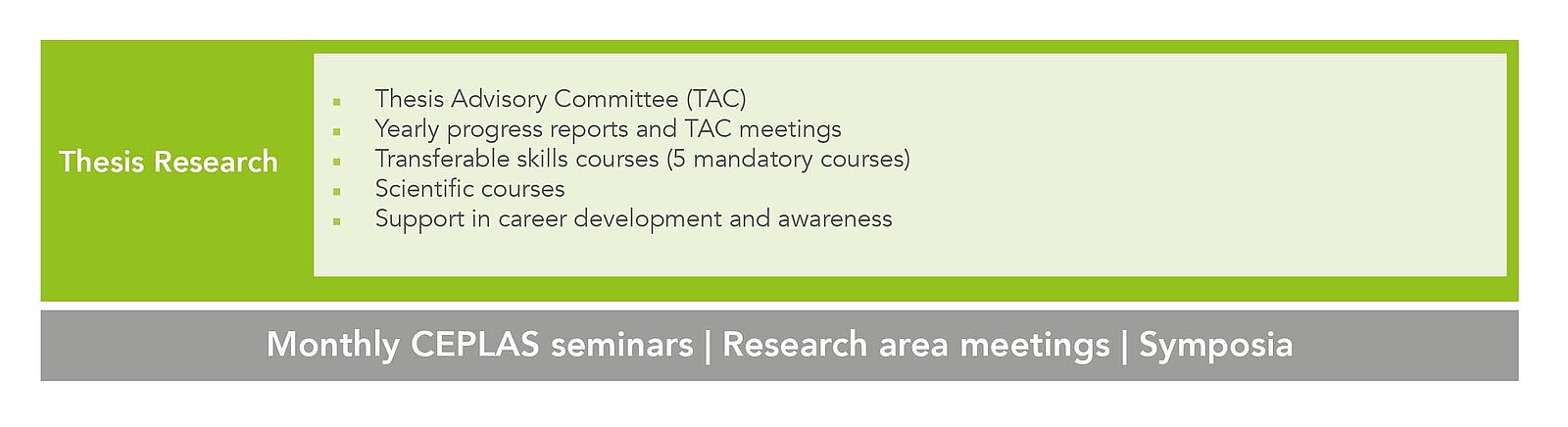
The Dissertation Phase
The CEPLAS Graduate School PhD program prepares doctoral researchers for successful careers in and beyond academia. Alongside their dissertation research, doctoral researchers benefit from a comprehensive training program that supports their scientific and professional development and addresses their individual career interests.
Dissertation Research and Supervision
The doctoral research project is at the heart of the PhD program and fosters the skills and independence required for a successful research career. Each doctoral researcher is supported by a Thesis Advisory Committee (TAC), consisting of their main supervisor(s) and one or two additional scientists from within or outside CEPLAS. Regular TAC meetings provide scientific feedback and guidance throughout the research project. The PhD concludes with the submission of a written dissertation and an oral defense (disputation).
Training and Career Development
The training program prepares doctoral researchers for future careers in and beyond academia through workshops focusing on transferable skills. Doctoral researchers are required to complete five transferable skills courses. Further activities, including industry excursions and networking events such as Speed Dating with Industry, provide insights into different career paths and opportunities to connect with potential employers. Scientific courses further strengthen doctoral researchers' research skills.
